Crowded teeth, early tooth loss, and a shifting jaw are signs your child may need orthodontic treatment. Some signs show up in the teeth. Others show up in the way your child chews, breathes, or holds their mouth. Knowing what to look for can mean catching a problem while it’s easiest to fix.
Most parents can’t tell from looking whether their child needs orthodontic treatment — and that’s completely normal. That’s what the age 7 screening is for. But there are specific things to watch for that should move a visit higher on your to-do list.
Sign 1: Crowded or Overlapping Teeth
This is the most visible sign. If your child’s teeth don’t have room to come in straight — or if baby teeth are being pushed out of position by incoming adult teeth — the jaw may be too narrow for the teeth it needs to hold.
Crowding that starts in the baby teeth often gets worse, not better, as the larger adult teeth arrive. A palatal expander can widen the jaw while the bone is still soft enough to respond easily.
Sign 2: Early or Late Loss of Baby Teeth
Baby teeth follow a fairly predictable timeline. Most children start losing their front bottom teeth around age 6, with the rest following over the next several years.
If a baby tooth falls out much earlier than expected — due to decay, injury, or crowding — the teeth on either side can drift into the empty space, blocking the adult tooth when it tries to come in. If baby teeth are hanging on much later than expected, they may be blocking adult teeth from erupting properly. Either situation is worth checking.
Sign 3: Teeth That Don’t Come Together Properly
Watch how your child bites down. The upper teeth should sit just slightly in front of and over the lower teeth. If you notice any of the following, mention it at your next appointment:
Overbite: The upper front teeth cover too much of the lower teeth. A small overbite is normal. A large one is not.
Underbite: The lower jaw juts forward so the bottom teeth sit in front of the upper teeth. Underbites are best corrected while the jaw is still growing.
Crossbite: Some upper teeth sit inside the lower teeth when the mouth closes. This can cause the jaw to shift to one side over time.
Open bite: The upper and lower front teeth don’t meet at all when the back teeth are together. This can affect speech and chewing.
Our post on common orthodontic problems goes deeper on each of these bite issues.
Sign 4: A Jaw That Shifts, Clicks, or Pops
If your child’s jaw shifts to one side when they close their mouth — or if they mention clicking, popping, or jaw discomfort — don’t brush it off. A shifting jaw often signals a crossbite. The jaw is moving to find a comfortable resting position because the teeth aren’t fitting together correctly.
Sign 5: Mouth Breathing
Kids who breathe through their mouths — especially at night — may have airway or jaw development concerns worth looking at. Mouth breathing can signal that the nasal airway is obstructed, and a narrow palate is one common reason why.
Dr. Barrett looks at airway and breathing as part of the full orthodontic picture. Catching breathing issues early can make a real difference in how a child grows and sleeps.
Sign 6: Difficulty Chewing or Biting
If your child avoids certain foods, chews only on one side, or complains of jaw soreness after eating, their bite may not be working efficiently. Teeth that don’t fit together well make chewing harder than it should be.
Sign 7: Habits That Have Gone On Too Long
Thumb sucking is normal in toddlers. But if it continues past age 4 or 5, it can push the front teeth forward and narrow the upper jaw. Tongue thrusting — pushing the tongue against the teeth when swallowing — has a similar effect. If your child has had these habits for a long time, an orthodontic evaluation can show whether any structural changes have occurred.
What Age Should I Start Looking?
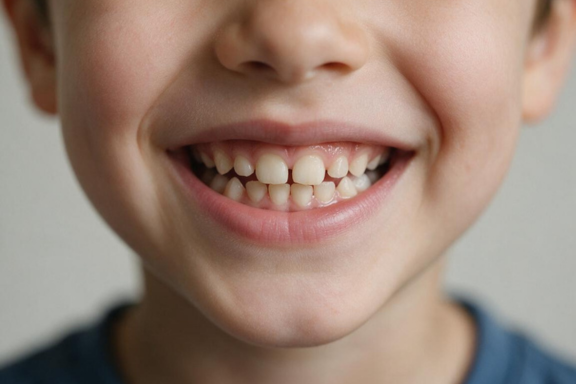
The American Association of Orthodontists recommends that every child see an orthodontist by age 7. At that age, enough adult teeth have come in to give a clear picture of bite development — but the jaw is still growing and responsive if something needs to be addressed.
If you’re more focused on whether it’s the right time to go — rather than what symptoms to watch for — our page on the right age for an orthodontic consultation walks through that question. For a broader look at orthodontic warning signs across all ages, see signs you need an orthodontist.
What Happens If We See a Sign?
Spotting a sign doesn’t mean your child needs treatment right now. It means it’s time to get a clear picture.
At Aubrey Barrett Orthodontics, a first visit includes a clinical exam and, if needed, low-radiation digital X-rays and an iTero digital scan — no messy impressions. Dr. Barrett looks at tooth position, jaw development, and bite alignment together.
If something needs attention, she’ll explain whether that means starting early orthodontic treatment now or simply monitoring and returning in 6–12 months. Some children benefit from Phase 1 treatment in the elementary years. Many can wait until the teen years. A few need nothing at all.
When to Call Sooner
Don’t wait for the age 7 milestone if you see:
- A jaw that visibly shifts when your child bites down
- Persistent mouth breathing or snoring
- Front teeth that protrude and could get knocked out
- A baby tooth lost significantly earlier than expected
- Your child mentioning jaw pain or clicking
Consultations are always free at our El Cerrito and Pittsburg offices.
FAQ
At what age should I look for signs my child needs braces?
You can start paying attention as early as age 5 or 6, when baby teeth start falling out and the first adult molars come in. The American Association of Orthodontists recommends a formal screening by age 7 — early enough to catch problems while the jaw is still growing.
What does crowding look like in a young child?
Crowding often shows up as baby teeth that look pushed together, adult teeth erupting behind or in front of baby teeth that haven’t fallen out yet, or gaps closing too quickly. If the baby teeth look cramped, the adult teeth will likely be more crowded.
Can orthodontic problems fix themselves as kids grow?
Some mild spacing issues do resolve on their own. But bite problems — crossbites, underbites, significant overbites — do not fix themselves and typically get harder to treat as the jaw finishes growing. This is why early screening matters.
My child breathes through their mouth at night — is that an orthodontic issue?
It can be. Mouth breathing is sometimes linked to a narrow palate or airway obstruction. Aubrey Barrett Orthodontics looks at airway and breathing as part of the full evaluation. Mention it at your consultation.
Will an orthodontic consultation be scary for my child?
Orthodontic consultations at our El Cerrito and Pittsburg offices are gentle and low-pressure. The first visit is mostly looking and talking — no needles, no drilling. Dr. Barrett is known for making kids feel comfortable.