Most people know they need a dentist for a checkup. But when it comes to crooked teeth, a bad bite, or braces, it gets confusing fast.
Do you see your regular dentist? Do you need a specialist? Is there even a real difference?
Yes — and it matters more than most people realize. Orthodontist vs dentist is a common question, and a good one.
Here’s a clear breakdown of what each one does, when to see them, and why going to the right one makes a difference for your family.
What Does a Dentist Do?
A dentist is your primary oral health provider. After completing a university degree, they attend four years of dental school and earn a DDS or DMD. Their job is to keep your teeth and gums healthy.
Dentists handle:
- Routine checkups and cleanings
- Cavities and fillings
- Gum disease treatment
- Tooth extractions
- Crowns, bridges, and veneers
- Root canals
- Teeth whitening
- General oral health concerns
Think of your dentist like your family doctor. They catch problems early, treat common issues, and refer you to specialists when something more complex comes up.
What Does an Orthodontist Do?
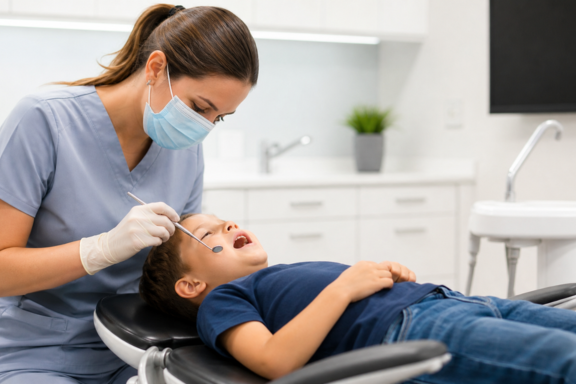
An orthodontist is a dental specialist. They complete the same four years of dental school as a general dentist — but then go on to complete an additional 2 to 3 years of specialized orthodontic training at a university residency program.
That extra training focuses entirely on one thing: how teeth, jaws, and the bite work together — and how to move them safely and precisely.
Orthodontists treat:
- Crooked or crowded teeth
- Gaps and spacing issues
- Overbites and underbites
- Crossbites and open bites
- Jaw alignment problems
- TMJ and bite-related discomfort
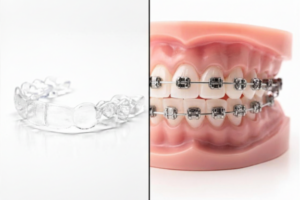
They use tools like braces, Invisalign, palatal expanders, and retainers to correct these issues over time.
The Key Difference in One Line
A dentist takes care of your oral health. An orthodontist straightens your teeth and corrects your bite.
Both are important. But they do very different jobs — and trying to substitute one for the other often leads to incomplete treatment.
Can a Dentist Do Braces or Invisalign?
Technically, yes. Some general dentists offer Invisalign as part of their services. But there’s an important distinction worth knowing:
A dentist who offers Invisalign is not an orthodontist.
Orthodontists spend years studying how teeth move, how forces affect the jaw, and how the bite functions as a whole. That depth of knowledge matters — especially for moderate to complex cases involving crowding, jaw issues, or bite problems that need precise correction.
For simple spacing cases, a general dentist may get acceptable results. But for most patients, seeing a trained specialist means better outcomes, fewer unexpected issues, and a smoother experience from start to finish.
When Should You See an Orthodontist vs Dentist?
See your dentist when:
- You’re due for a regular checkup or cleaning (every 6 months)
- You have a toothache, cavity, or chipped tooth
- Your gums are bleeding or swollen
- You need a filling, crown, or other restorative work
- You want teeth whitening
See an orthodontist when:
- Your child’s teeth are coming in crooked or crowded
- You notice a bite problem — teeth that don’t fit together properly
- You or your teen are interested in braces or Invisalign
- Your dentist refers you to a specialist
- Your child is around age 7 and has never had an orthodontic evaluation
Why Age 7?
The American Association of Orthodontists (AAO) recommends that every child have a first orthodontic evaluation by age 7. This doesn’t mean treatment starts at 7 — most kids won’t need braces until their early teens. But early evaluation lets an orthodontist spot problems while they’re still easier to address.
Some jaw and bite problems are actually much simpler to treat while your child is still growing. Catching them early can reduce the complexity and cost of treatment down the road.
At Aubrey Barrett Orthodontics, we offer early orthodontic evaluations for children throughout El Cerrito, Pittsburg, and the surrounding Bay Area communities. No referral required.
Does It Matter Which One You Choose?
For orthodontic treatment, yes — it makes a real difference.
An orthodontist brings:
- Specialized training your general dentist doesn’t have
- Years of experience focused specifically on tooth movement and bite correction
- Advanced tools for more accurate, efficient treatment planning
- A sole focus on getting your teeth and bite right — it’s all they do
Your dentist is an important part of your care team. Keep seeing them for your regular cleanings. But for braces, Invisalign, or anything related to alignment or bite, a specialist is the better choice.
What About Adults? Is It Ever Too Late?
Not at all. Orthodontic treatment works for adults at any age. In fact, a growing number of adults in their 30s, 40s, and beyond are getting treatment for the first time — or revisiting issues that weren’t fully corrected when they were younger.
Adult treatment often uses the same tools as teen treatment — braces or Invisalign — with adjustments for the fact that adult bone is denser and tooth movement may be slightly slower. You can read more about adult orthodontic options to see what’s possible.
Two Convenient Locations in El Cerrito and Pittsburg, CA
Dr. Aubrey Barrett is a board-trained orthodontic specialist serving families throughout the Bay Area from two convenient locations.
She completed her orthodontic residency at the University of Michigan — one of the top programs in the country — and has published research in the American Journal of Orthodontics and Dentofacial Orthopedics. She treats patients of all ages, from young children getting their first evaluation to adults who are ready for a change.
El Cerrito Office 511 El Cerrito Plaza, El Cerrito, CA 94530 📞 510-527-7111
Pittsburg Office 300 E. Leland Rd., Suite 205, Pittsburg, CA 94565 📞 925-439-3000
Open Monday through Thursday, 9am–5pm.
Book a Free Consultation — No Referral Needed
Not sure what your child needs? Or whether your own bite issue is worth addressing? Start with a free consultation.
Dr. Barrett will take a look at your teeth and bite, answer your questions honestly, and give you a clear picture of what’s going on — and what, if anything, needs to be done. No pressure, no commitment.