Your orthodontist just handed you a small bag of tiny rubber bands and said you need to wear them.
You probably have questions.
What do they even do? How do you put them on? Do you wear them while you sleep? What happens if you forget a day?
Here’s everything you need to know about rubber bands for braces — and why wearing them correctly is one of the most important things you can do to stay on track with your treatment.
What Are Rubber Bands for Braces?
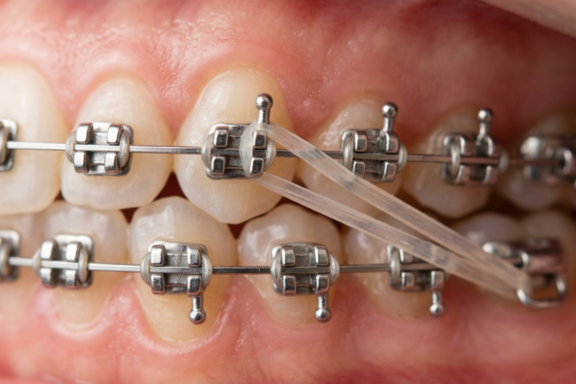
Rubber bands for braces — also called orthodontic elastics — are small stretchy bands that connect your upper braces to your lower braces.
They’re used with both metal and ceramic braces, and your orthodontist prescribes them when extra force is needed to correct how your upper and lower teeth come together.
They hook onto small metal hooks on your brackets, usually stretching from a tooth in your upper jaw to a tooth in your lower jaw. Depending on your treatment plan, they can be worn in different patterns on one or both sides of your mouth.
What Do Rubber Bands Actually Do?
Braces are very good at straightening individual teeth. But they can’t fix your bite on their own.
Your bite is about how your upper jaw and lower jaw fit together. When the bite is off — like with an overbite, underbite, or crossbite — rubber bands step in to help.
By stretching between your upper and lower teeth, rubber bands for braces apply gentle but steady pressure on your jaw. Over time, that pressure shifts how your upper and lower teeth come together.
Think of it this way:
- Braces straighten your teeth within each arch (top or bottom)
- Rubber bands align the two arches with each other
Without rubber bands, braces can leave you with straight teeth that still don’t bite together properly. Wearing them as directed is how you get a complete result.
Common Types of Rubber Band Patterns
Your orthodontist will tell you exactly which pattern to use. Common setups include:
- Class II (for overbites): The band hooks from an upper canine tooth toward the back of your lower jaw. This gently pulls the upper teeth back while moving the lower teeth forward.
- Class III (for underbites): The band hooks from a lower canine tooth toward the back of your upper jaw — the opposite direction.
- Vertical elastics: Worn up and down on the same side, often used to help close an open bite or improve vertical alignment.
Every patient’s rubber bands for braces setup is unique. Your orthodontist designs your routine specifically around what your bite needs to do. You can learn more about the common bite problems we treat to understand how your plan fits into the bigger picture.
How Long Do You Wear Rubber Bands Each Day?
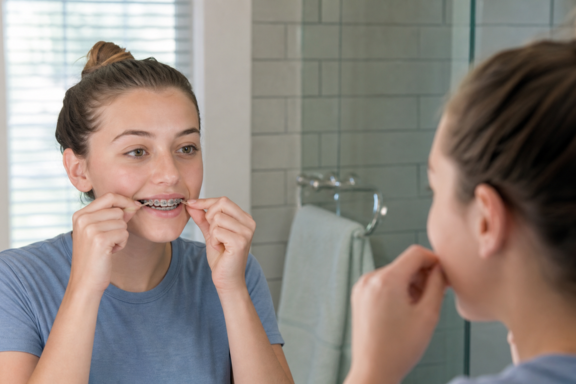
Most of the time. The standard instruction is 20 to 22 hours per day but your orthodontist will tell you the amount of time they need you to wear them.
You take them out to:
- Eat (food gets trapped and can tear the bands)
- Brush and floss your teeth
The rest of the time — including while you sleep — they should be in.
Yes, sleeping with them in is normal. Overnight is actually some of the most effective wear time because your jaw is relaxed and not working against the pressure.
How to Put On and Take Off Rubber Bands
It feels awkward the first few times. Most patients get comfortable with it within a few days.
Putting them on:
- Hook one end of the band over the upper bracket hook
- Use your fingertip (or the small plastic hook your orthodontist gives you) to stretch it down to the lower bracket hook
- Make sure it sits securely on both hooks
Taking them off:
- Use your fingertip to unhook one end
- The band releases easily — no need to force it
Change your rubber bands every 3-4 hours during the day (or as your orthodontist instructs). Elastics lose their tension throughout the day. Fresh bands = more effective force.
What Happens If You Skip Wearing Them?
Your bite won’t move the way it needs to.
Rubber bands are doing a specific job in your treatment plan. Skipping them — even for a day here and there — slows your progress. If you consistently wear them only part-time, your bite may not correct fully, and treatment will take longer than planned.
This is one of the most important compliance pieces of braces treatment. Your orthodontic appliances and care guide has more detail on what’s expected during treatment.
Common Questions About Rubber Bands for Braces
Will they hurt? You may feel some soreness when you first start — this is normal and usually fades within a day or two. If it’s severe or doesn’t improve, contact your orthodontist.
Can I eat with them in? Take them out before eating. Food can catch on them and they’re not designed to handle chewing force.
What if one snaps or breaks? Replace it right away with a new one. Always keep extra bands with you — at school, at work, in your bag. Running out is not an excuse to skip them, so ask your orthodontist for more when you’re getting low.
Do both sides need to be the same? Not always. Some patients wear rubber bands only on one side, or in different configurations on each side. Follow your orthodontist’s instructions exactly.
How long will I need to wear them? It varies. Some patients wear rubber bands for a few months. Others need them for most of their treatment. Your orthodontist will check your progress at each appointment and let you know where things stand.
Braces Treatment in El Cerrito and Pittsburg, CA

At Aubrey Barrett Orthodontics, Dr. Barrett and her team take the time to make sure you understand every part of your treatment — including exactly how and when to wear your rubber bands.
We treat teens and adults at both our Bay Area locations, and we’re always happy to answer questions between appointments.
Rubber bands are one piece of the larger care picture. For everything else — brushing technique, flossing with braces, food rules, and what to watch for — our guide to taking care of braces at home covers the full daily routine.
El Cerrito Office 511 El Cerrito Plaza, El Cerrito, CA 94530 📞 510-527-7111
Pittsburg Office 300 E. Leland Rd., Suite 205, Pittsburg, CA 94565 📞 925-439-3000
Open Monday through Thursday, 9am–5pm.
Thinking About Starting Braces?
If you or your teen are considering braces and want to understand the full picture before committing, start with a free consultation. Dr. Barrett will evaluate your teeth and bite, explain your options, and answer every question you have.
No referral needed. No pressure.